Why Your Paid Ads Feel Generic (And How to Fix It in 3 Steps)
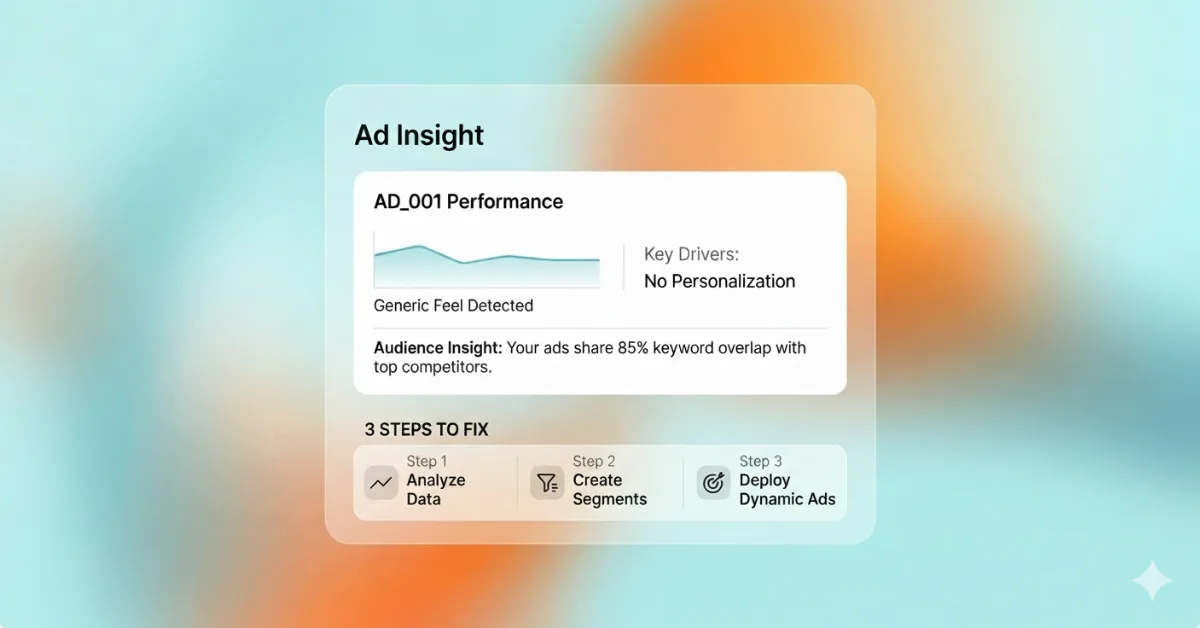
Scrolling through Instagram or Facebook, every third ad looks like it could be for anyone. Stock footage of people laughing in meetings. Vague promises about “transforming your business” or “unlocking growth.” A call-to-action that says “Learn More” because the ad itself didn’t actually explain what there is to learn.
Your own ads probably don’t look exactly like that. They might feel uncomfortably close. Professional, yes. Polished, sure. Forgettable, definitely. The kind of thing people scroll past without really seeing, because nothing in the creative gave them a reason to stop.
This has nothing to do with budget or production quality. Some of the most expensive ads we’ve audited felt generic despite costing thousands to produce. The problem wasn’t what you spent on making the creative—it was what you didn’t spend time figuring out before making it.
What Generic Actually Means
Generic surfaces when an ad could work for multiple different companies with minimal changes. When the specific details about who you are, what you actually do, and why anyone should care have gotten sanded down to category-level boilerplate.
“We help businesses grow” could mean anything. Not wrong—you probably do help businesses grow. Thousands of other companies grow things too, and that sentence does nothing to separate you from them. It’s a placeholder for a message you haven’t worked out yet.
The fix isn’t trying harder to be different. Specificity handles that. What does your company do that others don’t? Who specifically is it for? What problem do they have that they’d nod at if you described it back to them?
Specificity makes creative land, because specificity is what makes creative relevant to someone. The more precisely you describe a problem or a person or an outcome, the more strongly the right people recognize themselves—and the less the wrong people waste your ad spend.
Three Patterns That Kill Ads
We audit creative for clients constantly, and the same three patterns keep surfacing in work that feels empty. None of them requires more budget to fix. They require sharper thinking.
1. No Point of View
The safest ad offends nobody and interests nobody. Describes what you do in the most neutral possible terms. Makes claims so broad they can’t be disputed. Presents information assuming everyone should care equally.
Nobody cares equally. People care about things that relate to their specific situation, their specific frustrations, their specific goals. An ad without a point of view can’t speak to any of that because it’s trying to speak to everyone at once (which is really speaking to no one).
Point of view means taking a position on something your audience cares about. What do you believe that your competitors don’t? What trade-off have you made that defines who you’re for and who you’re not? What problem do you think is getting solved wrong by everyone else?
A skincare brand positioning around “you don’t have sensitive skin, you have skin that’s been sensitized by harsh ingredients” has a point of view. Specific. Disputable. It’ll resonate hard with people who felt that frustration and nothing with people who haven’t. That asymmetry is the whole point. Generic ads chase resonance equally with everyone and end up resonating with nobody.
2. Vague Benefits Instead of Specific Outcomes
“Increase your revenue.” “Improve your efficiency.” “Transform your marketing.” These phrases breed in thousands of ads because they sound like benefits without committing to anything verifiable. You can always claim your product increases revenue or improves efficiency—those words stretch enough to mean almost anything.
What matters to someone considering your product isn’t whether you “improve efficiency” in some abstract cloud. It’s whether you solve the specific efficiency problem they’re living with right now. Can you save them three hours a week on something they hate? Can you eliminate a bottleneck that’s been choking their team? Can you make them dread something less because they spend less time on it?
The more specific you get about the outcome, the more valuable the ad becomes to people it’s for—and the easier they self-select. Say “save time on reporting” and everyone nods vaguely and keeps scrolling. Say “turn end-of-month financial reporting from a two-day project into a 30-minute task” and the people doing that two-day project stop scrolling.
You lose the people who don’t have that problem. Fine. They weren’t buying anyway. What you gain is actual relevance to the people who do have that problem and are actively looking for solutions.
3. No Proof That Matches the Claim
Most B2B ads make impressive-sounding claims and provide no evidence that any of it holds water. “Trusted by industry leaders” with no names. “Proven results” with no numbers. “Award-winning” without specifying what award or why it matters.
This opens a trust gap. The person seeing your ad has been lied to by advertising before. They’ve clicked on claims that turned out inflated. They’re not going to believe you just because you said something with confidence.
What closes that gap? Specific proof. Instead of “trusted by industry leaders,” show a recognizable logo and a specific outcome: “Used by Gojek to reduce onboarding time by 60%.” Instead of “proven results,” give a number that means something: “Our clients see an average RPV increase of 47% in the first 90 days.”
Specificity does two things. First, it makes the claim falsifiable, which weirdly makes it more credible—you wouldn’t give specific numbers if they weren’t real, because someone could check. Second, it helps potential customers pattern-match: “If it worked for a company like that, maybe it could work for us.”
A Real Example: The Generic Ad Audit
A SaaS company burned $30,000 over three months on ads that generated leads and almost no trials. They couldn’t figure out why—the creative looked professional, the landing page was clean, the product solved a real problem.
Their ad said:
“Transform your team’s productivity with AI-powered project management. Trusted by innovative companies worldwide. Streamline workflows, eliminate bottlenecks, and deliver projects on time. Start your free trial today.”
Everything in that ad lands true. Nothing in that ad moves. Let’s tear it down:
No point of view: The ad positions the product as project management software with AI, which describes a category and nothing beyond it. What does this company believe about project management that others don’t? Why did they build this instead of using what already exists? The ad leaves that question hanging.
Vague benefits: “Transform productivity,” “streamline workflows,” “eliminate bottlenecks”—these phrases live in any project management ad. They don’t describe a specific outcome or solve a specific problem. Someone reading this has no map of whether the product is for them.
No proof: “Trusted by innovative companies worldwide” means nothing. Which companies? What makes them innovative? What did trust look like in practice? Without specifics, this is just texture with no substance.
The Fix: Three Steps to Specificity
We spent a week talking to their best customers—actually talking, not surveying. We wanted to understand what made them choose this product over alternatives, what problem it solved that they couldn’t solve another way, what their workflow looked like before versus after.
What bubbled up: their best customers weren’t looking for “project management” in general. They were looking for a solution to something specific: their teams used four different tools for different parts of the workflow, and nothing talked to each other. They spent hours each week copying information between systems, losing context every time someone had to switch tools, watching projects slip through cracks because nobody had visibility into the whole picture.
The product solved that specific pain by integrating everything into one place with AI handling the tedious part of connecting systems. That’s not generic—that’s a specific outcome for a specific type of customer with a specific pain point.
We rewrote based on that insight:
Step 1: Take a Position
“Your team doesn’t need another project management tool. You need to stop using five of them.”
This takes a position on what the actual problem is (fragmentation across tools). Someone using one project management system won’t care. Someone juggling multiple tools and feeling that friction will stop scrolling.
Step 2: Describe the Specific Outcome
“Replace Asana, Slack, Google Drive, Jira, and your spreadsheet with one platform that actually talks to itself. No more copying task updates between tools. No more hunting for the latest version of a file. No more wondering what everyone’s actually working on.”
Now we’re describing specific outcomes: consolidating five tools into one, eliminating specific frustrations they recognize (copying updates, finding files, losing visibility). This isn’t for everyone. It’s for people living with that specific friction.
Step 3: Provide Specific Proof
“Engineering teams at [recognizable tech company] and [recognizable startup] reduced time spent on tool-switching from 8 hours per week to under 1 hour—and shipped 23% faster in their first quarter using the platform.”
Real companies (with permission), real numbers, real outcomes. Proof that works for people similar to those companies with similar problems.
The Results
Generic ad: $30,000 spend, 47 trials, 4 conversions to paid ($7,500 CAC)
Specific ad: $30,000 spend, 29 trials, 11 conversions to paid ($2,727 CAC)
Fewer trials, higher-quality trials from people who actually had the problem the product solves. The specific ad generated 175% more customers at 64% lower cost per acquisition. Not because the creative was more beautiful. Because it was more relevant.
Your Three-Step Audit
If you suspect your own ads feel generic:
Step 1: The Swap Test
Take your ad copy and remove your company name. Could any of your competitors use this with minimal changes? If yes, you don’t have a point of view. You’re describing a category, not a position within it.
Fix: Ask yourself: what do we believe about solving this problem that’s different from how competitors approach it? What trade-off have we made? Why did we build this specific solution instead of something else? Put that perspective in your ad.
Step 2: The Specificity Test
Circle every claim or benefit in your ad. For each one: could I make this more specific? Instead of “save time,” could you say “save 3 hours per week”? Instead of “improve efficiency,” could you describe the exact task that becomes faster?
Fix: Replace every vague benefit with a specific outcome. If you can’t quantify it or describe exactly what changes, you don’t actually know what your product does for people. Which means you need to talk to customers before writing better ads.
Step 3: The Proof Test
Look at any credibility claims—customer logos, testimonials, result statements. Are they specific enough that someone could theoretically verify them? Or are they generic enough that they could mean anything?
Fix: If you have real results, use real numbers. If you have real customers, name them (with permission). If you have testimonials, include specific outcomes they achieved. Specificity builds trust. Vagueness erodes it.
Why Most Ads Stay Generic
Most creative ends up feeling generic because of fear, not laziness. Specific ads risk alienating people. Generic ads try to appeal to everyone, which feels safer.
Here’s what actually happens: generic ads appeal to no one, because no one sees themselves specifically in the message. Specific ads don’t alienate most people—they just don’t waste their time. They strongly attract the right people, which is what advertising actually does.
The brands we work with that have the best-performing creative aren’t playing it safe. They’re being honest about who they’re for, what problem they solve, and what outcome someone can expect. That specificity makes the creative interesting. Interesting is what stops someone mid-scroll.
Your ads don’t need to be more clever. They need to be more specific. Start there.
Keep reading
View more → Strategy
 Strategy
 Creative
 Growth
 AI
AI