How to Audit Your Creative Without Hiring an Agency (Yet)
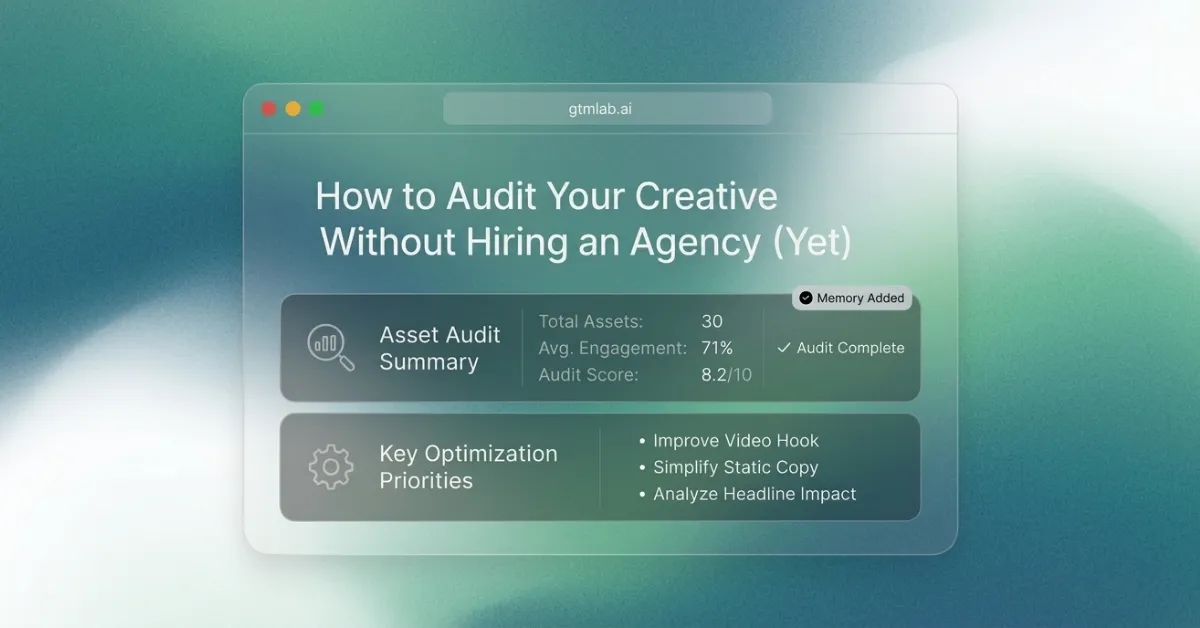
You know something is wrong with your paid ads. Cost per acquisition has been climbing. Creative that used to work suddenly doesn’t. You’re spending $10K monthly but can’t figure out why some campaigns convert and others don’t.
You know you need help, but you’re not ready to hire until you understand what kind of help you actually need. This is the diagnostic gap—the space between “something isn’t working” and “here’s exactly what’s broken.”
You can audit your own creative. Not to become a strategy expert, but to understand whether creative quality is actually your bottleneck, or whether your problems live elsewhere.
Is Creative Actually Your Problem?
Many founders blame creative when the real issue is product-market fit, pricing, poor landing page experience, or traffic quality. Fixing creative won’t help if people are converting well from good traffic but your ads attract the wrong audience.
Pull your last 30 days of data and look at three metrics:
Click-through rate (CTR): Below 1% on Meta or 2% on Google means your ads aren’t compelling. Creative is likely a constraint.
Landing page conversion rate: If people click but fewer than 2% convert, creative isn’t your primary problem. Fix the landing page first.
Cost per acquisition relative to target: Within 20% of your target and creative optimization might close the gap. Off by 2–3x and creative alone won’t fix it—you have structural problems with targeting, pricing, or fit.
If CTR is reasonable but conversion and CAC are way off, your problem isn’t creative. If CTR is low and CAC is high, creative is worth auditing.
The Six-Element Audit
Element 1: Scroll-Stopping Power
Open your ads manager and look at your highest-spend campaigns from the last 30 days. Study the first three seconds of each video or the main image of each static ad.
Would you personally stop scrolling? Not “would someone”—you.
If no, what’s making it forgettable? Generic stock imagery that could be any brand. No human faces. Too much text. Visual that doesn’t communicate what you actually offer. Aesthetic that blends into the feed.
Show the first frame to three people who don’t know your business. Ask: “What do you think this ad is for?” If they can’t answer in three seconds, your visual isn’t working.
Element 2: Message Clarity
Read the first sentence of your ad copy (or first three seconds of video). Does it communicate what you do, who it’s for, and why anyone should care?
Or does it start with vague scene-setting that takes too long to reach the point? Common mistakes: opening with “Imagine if...” that leads nowhere. Starting with your company name instead of customer problem. Describing your solution before establishing why anyone needs it.
If you removed your company name and logo, could someone tell what category of product this is? If not, you’re not being clear enough.
Element 3: Emotional Resonance
Creative that performs connects to how someone feels about their problem, not just what you do. Does your messaging acknowledge the emotional reality of your customer?
Logical: “Our project management software reduces time on status updates by 60%.”
Emotional: “Stop spending Friday afternoons updating spreadsheets nobody reads. Get back to the work that actually matters.”
The logical version describes an outcome. The emotional version makes someone feel seen. Both can work, but emotional versions tend to perform better because they acknowledge how it actually feels to have this problem.
Read your copy out loud. Does it sound like something a human would say to another human? Or does it sound like marketing copy checking boxes?
Element 4: Social Proof Relevance
Generic social proof doesn’t move the needle. What matters is whether the proof is relevant to the person seeing it.
Are you showing logos of companies your target customers would recognize? Are testimonials specific enough to be credible? Do result statements feel achievable?
Common mistakes: logos of nobody-has-heard-of companies. Testimonials saying “Great product!” without specifics. Results that feel too good to be true. Social proof from the wrong audience tier—showing enterprise clients when targeting SMBs.
If you’re reaching $5M-revenue companies, proof from $100M companies creates a mismatch. People pattern-match to customers like them.
Element 5: Call-to-Action Clarity
What exactly are you asking someone to do, and why should they do it now?
Do your CTAs specify what happens next? “Download the guide” beats “Learn more.” Do they create genuine urgency without false urgency? Are they matched to awareness stage—asking for demos to cold audiences is premature.
Common mistakes: generic CTAs that don’t specify what people are learning. Asking for too much commitment too early. No CTA at all. Multiple CTAs competing.
After reading your ad, could someone articulate exactly what you want them to do next? If there’s confusion, simplify.
Element 6: Format-Audience Fit
Different creative works for different stages of awareness. Cold audiences need native-looking content that doesn’t scream ad, quick hooks establishing relevance, problem-focused messaging before solution, and shorter videos (15–30 seconds). Warm audiences respond to detailed explanations, social proof, longer videos (60+ seconds) showing how your product works, and direct response with clear offers.
If you’re running the same creative to cold and warm audiences, you’re leaving performance on the table.
Pattern Recognition
Pull every piece of creative from the last 6–12 months. Group by concept: problem-focused versus solution-focused, feature versus outcome, emotional versus logical, customer-story versus brand-story, short-form versus long-form.
Look at performance by concept type, not individual ad. Which concepts consistently perform better? Maybe every time you lead with customer problems, conversion rates are 2x higher. Maybe emotional messaging outperforms logical. These patterns tell you what to make more of and what to stop making.
Identify Your Gaps
You should now have a specific list of creative problems. Maybe scroll-stopping power is weak (low CTR) but message clarity is fine—that’s a visual design problem. Maybe scroll-stopping is good but conversion is low—that’s message-market fit. Maybe creative works for warm audiences but fails for cold—that’s awareness-stage mismatch.
Whatever you find, you have a diagnosis instead of a vague sense that “creative isn’t working.”
What to Fix First
Prioritize by impact:
Highest impact: Scroll-stopping power (if CTR is below 1–2%), message-market fit (if CTR is fine but conversion is low), format-audience mismatch (if some audiences convert but others don’t).
Medium impact: Social proof quality, CTA clarity, emotional resonance.
Lower impact: Production quality improvements, copy refinements, button color testing.
Start with what moves the metrics most. Usually that’s getting more people to stop scrolling or getting more people who stop to convert.
When to Hire Help
You should bring in an agency when you’ve identified specific problems but lack the skills to fix them. Knowing what’s wrong is valuable—you can hire the specific skill you need. Bring help when you’ve iterated for 3+ months without improvement. Hire when you’re ready to scale but creative is the constraint. Bring people in when your time is better spent elsewhere and you can afford to hire.
The Real Payoff
Even if you hire an agency afterward, running this audit first gives you leverage. You’re not saying “our ads don’t work, please fix them.” You’re saying “we’ve identified that scroll-stopping power is our constraint—CTR is below 1% despite right targeting. We need creative that breaks through.”
Agencies can skip the discovery phase where they try to diagnose problems (often wrong) and jump straight to solving what you’ve identified. You can evaluate them better—you’ll know whether they’re addressing your actual constraints or selling generic services.
Most importantly, this audit teaches you what good creative looks like for your business. That education compounds. You’ll make better decisions about strategy, better briefs for whoever executes, and better judgment when reviewing what gets produced.
You don’t need to become a creative expert. Understanding what makes creative work for your business is one of the highest-leverage skills you can develop as a founder running paid acquisition.
Keep reading
View more → Strategy
 Strategy
 Growth
 AI
AI Creative